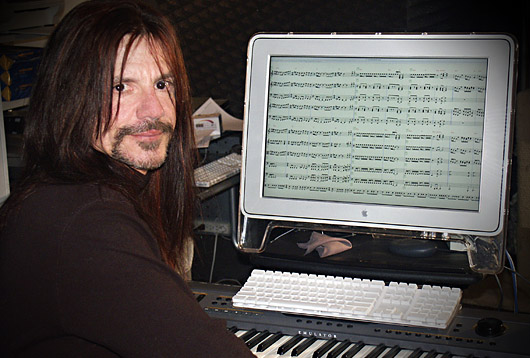
| Jack
Hale - Nashville record producer video features

"Know
what you are doing, know your craft, be overly prepared
for all projects – trust your ears" say's
Jack. Watch our seriously in-depth video interview with
Jack Hale at Hale House. The videos are in three parts
and are for broadband viewing.
Jack
Hale was born into a family of musicians. Jack's father
and uncle Dr. Ralph Hale have long been well respected
within the industry. Embarking on musical studies quite
late, at age 13 - as his father did not want to be accused
of pushing Jack into the business -Jack began playing
trumpet with his uncle. As his teachers and mentors,
his father and uncle would play a huge role throughout
Jack's amazing career – whether helping with the
physical issues associated with brass playing or preparing
Jack for his first conducting gig with a major symphony.
Shortly
after Jack began playing, he knew that being a musician
would be his life’s work. "We were not wealthy,
but comfortable and happy as a family – also I
was an only child. My father laid down the law about
practice, study, etc. so I was not allowed to take on
summer jobs. I earned my “allowance” by
practicing and studying. I always had everything a kid
would want, so I had no excuses about having it hard
and therefore could devote the time necessary to develop
my talent and skills" say's Jack. This was the
start of Jack's single minded determination to making
a success and leaving his mark on the industry.
Jack
began watching recording sessions before ever playing
a note, getting to know the main guys involved in those
huge records recorded in Memphis at the time: Al Green,
Box Tops, Elvis, Isaac Hayes, B.J. Thomas, Bar Kays
and ZZ Top. "I had the contacts that would get
me started in my career before I had one! Talk about
fortunate!"
"At
Christian Brothers High School, I was treated like I
was going to be a professional musician, my uncle Ralph
was the Band Director/music instructor, and actually
everyone who was in his band got the same treatment!"
The high school at that time had the highest percentage
of graduates who went on to professional music careers
in the country.
While attending the University of Memphis, Jack's musical
instructors tailored his education toward commercial
music – this was 15 years before commercial music
degrees became available. "I chose U of M because
I was able to get session work and do a lot of 'hanging'
that I would not have been able to do elsewhere."
Jack acknowledges that he was incredibly lucky to have
such great teachers at the University . "I was
taught classical composition and exposed to other music
comp stuff – like jazz, arranging, current contemporary
techniques, etc. I felt early on that producing was
something to check into later in life, having watched
Arif Mardin in Miami record the Memphis Horns on some
Aretha Franklin/King Curtis classic stuff – he
seemed to have more fun than anyone – and everyone
was having a great time!" All this led Jack to
choose music composition as his major and he learned
how to engineer a bit later.
John
Fry owned (and still owns) Ardent studio in Memphis
and Joe Hardy (a legendary engineer in his own right)
“gave me the keys” to the studio when it
was not being used. "This was and still is one
of the finest studios I have ever set foot in!"
"My goal was to become as knowledgeable as I could
about music, music theory, arranging, performing, etc.
as well as the technical side of recording – both
sides of the console, if you will. To me that is something
a producer should bring to the table – the ability
to write parts AND record them if need be." Jack
jokes that Willie Mitchell could pick out any five guys
off the street, hand them instruments and leave that
afternoon with a hit record. "He can do it all
- listen to the chords he wrote in 'Let’s Stay
Together. He wrote the song and produced it. Listen
to anything Mutt Lang has a hand in – what a creative
musician! I had an inside track to the latest tech offerings
like the Fairlight CMI, digital effects processing,
MIDI, etc. Remember this was the early ‘70’s."
In
1977 Jack Hale became the “official” trumpet
player with the Memphis Horns which led to great things,
one of which that was touring with Johnny Cash. "He
had a tour of California around 1980, and I had just
found out the Memphis Horns were going to take a bit
of a hiatus having been going really hard for so long.
I got a call from his office to go on a 10-day tour,
which ended up being about a 10 year run! During that
time I also became his musical director and had the
opportunity to do many things and meet some great people.
I am the most fortunate guy on earth!"
After
that unexpected and rewarding period Jack began making
the transition into full time production and started
his production company 'Hale House Productions'.
"Remember
a producer may be getting around 40% of the gross budget
plus points to 'produce', so you can see from an economic
standpoint how important it is to make this decision
correctly as an artist. Also keep in mind that to call
yourself a producer requires only that you claim to
be one. There are no tests to pass, licenses to hold.
The person who paints houses and the person who painted
the Mona Lisa are both skilled craftsmen who work with
paint. This is very analogous to being a producer".
Jack
believes a producer should be one of the best and most
creative musicians in the studio (not to be confused
with instrumentalist) and he/she should have enough
technical expertise to get the sound they want in case
the engineer or equipment is not up to the task. Having
good instincts about music in general and having impeccable
'ears' are indespensible tools of the trade.. "Joe
Hardy would set me up to get knocked down when I first
started out. He’d say ‘which do you think
sounds best?' and I would pick one – then he’d
say, 'they are the same, you idiot!" “Use
your ears and know what you are talking about”
say's Jack.
"You
can’t have too much knowledge of music, history,
technology, human nature, finance, whatever. Never stop
learning. You must relate to each artist as an individual
entity. Be the 'fifth Beatle' like George Martin. Song
selection, album order, instrumentation, even effect
usage are critical elements. Remember, when you hear
something that has just been released, it may have been
5 years in the making. Keeping an awareness of current
trends is mandatory, but don’t limit your creativity
to just what’s popular. That’s the past
from a production standpoint. You need knowledge to
make the right decisions quickly and the time to treat
each project, as it’s the only thing in your life."
"Production
is not a normal profession – it is a lifestyle,
in my experience. You need to be a psychologist at times,
a doctor, physical therapist, music educator, instructor,
and a friend 24/7 to your artists. I happen to be a
people person, so I enjoy making new friends and in
general helping people take their music to the next
level, whatever that may be. I also like to dig into
other’s music to find what makes it cool for me.
My way is to write out stuff, and make notes away from
the studio environment. I memorize a lot of stuff while
doing that, and “play it in my head”. When
you do that you don’t hear a lot of the “horrible”
things that may be on the track you have to listen to
like out of tuneness, wrong chords, etc.. Our memory
recollection kind of filters out that stuff…well
I know mine does!” I also get arranging and recording
ideas that way. Don’t work with someone or a group
you don’t get along with, even if you love their
music. It’s not fair to the artists and not fair
to the outcome of the project. You can end up spending
huge parts of your life with these people and if you
start off not getting along…well, you’ve
heard stories!"
Jack
also describes himself as a guy who likes to read manuals,
and does a lot of experimentation when not working.
"If someone sees and hears me as an engineer, I
hope to come off as a great one – like that is
all I do - same with arranging, playing, mixing, programming,
etc. You can be that good – it does take a degree
of talent and a lot of time. I am fortunate to beta
test a lot of incredible software and hardware –
how cool is that? It’s a lot like seeing the future
– what you do with it is another matter. It also
helps to have a great support crew - family, friends,
doctors, lawyers, other engineers, arrangers, producers,
tech guys you can turn to."
Jack
thinks that it's a great time that we are in now, with
the ability for music as an art to recapture audiences.
On the Seals and Crofts’ 'Traces' album that Jack
produced, he believes that more revenue is generated
from online downloads than actual CD sales. "Granted,
you are selling less than the entire CD most of the
time and the artwork part of the CD has not really gotten
it’s due online yet, but there is no warehousing,
'returns' or physical distribution involved. This makes
the potential to realize a profit faster, or put another
way more money can be spent “making” the
music/record. As for the artwork, I can see where this
could be a huge selling point for downloading –
imagine video, not just a static picture, for an album
cover. The consumer could even design their own cover
from elements online pertaining to the record. I think
we are still in the early stages of this new era, so
it’s anyone’s guess."
There
are so many producers and ways to produce it may seem
there are too many choices to make. "That is why
picking the right producer for your own project will
save you time, money and frustration while giving you
more for your project than you could imagine. If a producer
says they want to work with you, and gives you a price
without getting you in the studio or listening to your
material, be wary. For me to taking on a project requires
that I believe in the project – maybe it’s
not going to sell millions, but it will have integrity
and a musical statement I will stand behind in front
of the world. If you don’t believe something is
ever going to sound good, leave it alone."
When
you first start out, you take what you can get say's
Jack. "You have to in order to build your 'archive'
to show others and get more work. Even at the early
stage, you can’t hide behind 'there was no money…no
time, the guy couldn’t sing, whatever". “That’s
where creativity and knowing your craft can at least
give you something that has some unique elements to
it.” "Think of the public – when they
buy a track, they do not know that one artist may have
a 6 million dollar budget and another may be recording
on a shoestring. All they know is one sounds good and
one sounds not so good – you can’t put disclaimers
in there saying I ran out of time and money. This starts
the first time you call yourself a producer, so it’s
good to know before you get involved."
Sensibly,
Jack rented expensive mic pre’s before buying
his own in order to get the sound he wanted. "I
ended up either going in the hole or making very little
but I got stuff I could use as examples. Look at it
as paying for education – plus you are building
your reputation. Never allow others to influence you
to the point of “producing by committee”
if your name is going to be the only one on the record
as producer, you are the person who gets the glory or
gets slammed. I have found that pets, boyfriends, girlfriends,
wives, husbands, children, strangers on the street,
trees, bushes – everyone and everything has an
opinion. I only give out early mixes for work purposes
and only include what is necessary. You can assume the
work track is going to be scrutinized by the entire
community, so keep it extremely raw and/or minimal!"
"I
know the material better than the artist who may have
written it before we hit the record button. After careful
thought I’ll discuss my ideas and gather other
ideas that may have developed from the artist. I know
what I want it to sound like in my head and know how
to achieve that sonically and through the music/arrangement
end. I like to write a lot of notation and make a lot
of notes – even if it’s is just for me.
That’s producing in a nutshell as far as I’m
concerned."
"Know
what you are doing, know your craft, be overly prepared
for all projects – trust your ears" say's
Jack.
Jan 2006
Special
thanks to Jack for giving up so much of his time to
help us set up this feature - but we would like to add
that Jack has been invaluable in helping film our first
Nashville producer feature series for 2006. Thank you
Jack for all of your help! Special thanks also go to
Johnny Jaskot of Babblefish.com
for his superb interview, camera work and editing!
Jack Hale would like to give special thanks to his
father Jack Hale, my 2nd father CONTACT _Con-4117ABA740
\c \s \l Willie Mitchell,, Joe Hardy, Niko Lyras, John
Hampton, The Memphis Boys, and John Fry.
|